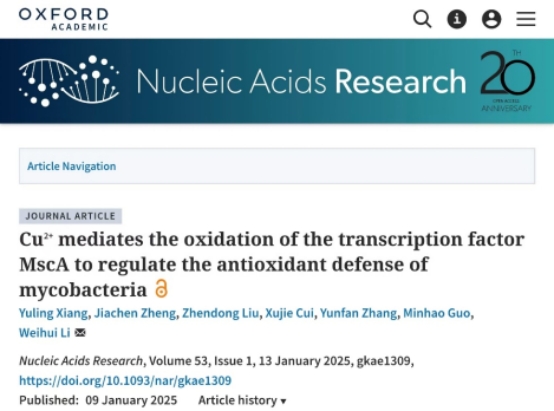
A team fromSchool of Life Science and TechnologyatGXUhas recently achieved notable progress in bacterial antioxidant defense research. The study, entitledCu2+ mediates the oxidation of the transcription factor MscA to regulate the antioxidant defense of mycobacteria, appeared in the esteemed journalNucleic Acids Research. The work is led byXiang Yuling, a doctoral student from the 2021 class atSchool of Life Science and Technology, with ProfessorLi Weihuiof the same institute serving as the corresponding author, andGXUacting as the sole corresponding institution.
Mycobacteria, which belong to the actinobacteria group, are commonly found in nature. However, during their survival, they encounter various stress factors, among which oxidative stress is both prevalent and critical. Despite its significance, little is understood about how mycobacteria respond to and adapt to oxidative stress at the molecular level. Copper (Cu), a trace element with redox properties, plays a dual role in biological systems—essential for life but also potentially toxic. Due to its redox abilities, copper serves as a cofactor for many proteins, but it can also cause oxidative stress if not properly regulated. Consequently, maintaining cellular copper balance is crucial. The role of Cu2+ in regulating bacterial antioxidant defense, however, remains unclear, and the mechanisms behind this remain to be explored.
For the first time, this research introduces a Cu2+-responsive transcription factor, MscA, involved in regulating bacterial oxidative stress responses. Cu2+ directly interacts with the cysteine residues of MscA, initially forming a coordination bond and then oxidizing cysteine to form a disulfide bond. This leads to the oligomerization of MscA, inhibiting its DNA-binding capability. As a result, Cu2+ reduces the expression of antioxidant genes, contributing to higher levels of ROSand oxidative damage in mycobacteria. This groundbreaking discovery establishes a direct connection between Cu2+ and bacterial antioxidant defenses, offering new perspectives on how bacteria cope with environmental stresses.

Reports indicate that the research received funding from various projects such as National Key R&D Program of China, National Natural Science Foundation of China,GuangxiScience Fund for Distinguished Young Scholars, andBagui Youth Talent Support Program, among other sources.
 ການຄົ້ນຄວ້າ> Content
 ການຄົ້ນຄວ້າ> Content

 Address: No.100,East Daxue Road,Xixiangtang District,Nanning, Guangxi,China
 Postal Code: 530004
 Tel: 86-771-3238863
 Email: gjc@gxu.edu.cn